
“Quo Vadisˮ (Trabant)
1990, original version: metal, fiberglass, 310 × 390 × 170 cm, a bronze cast of the work (2001)
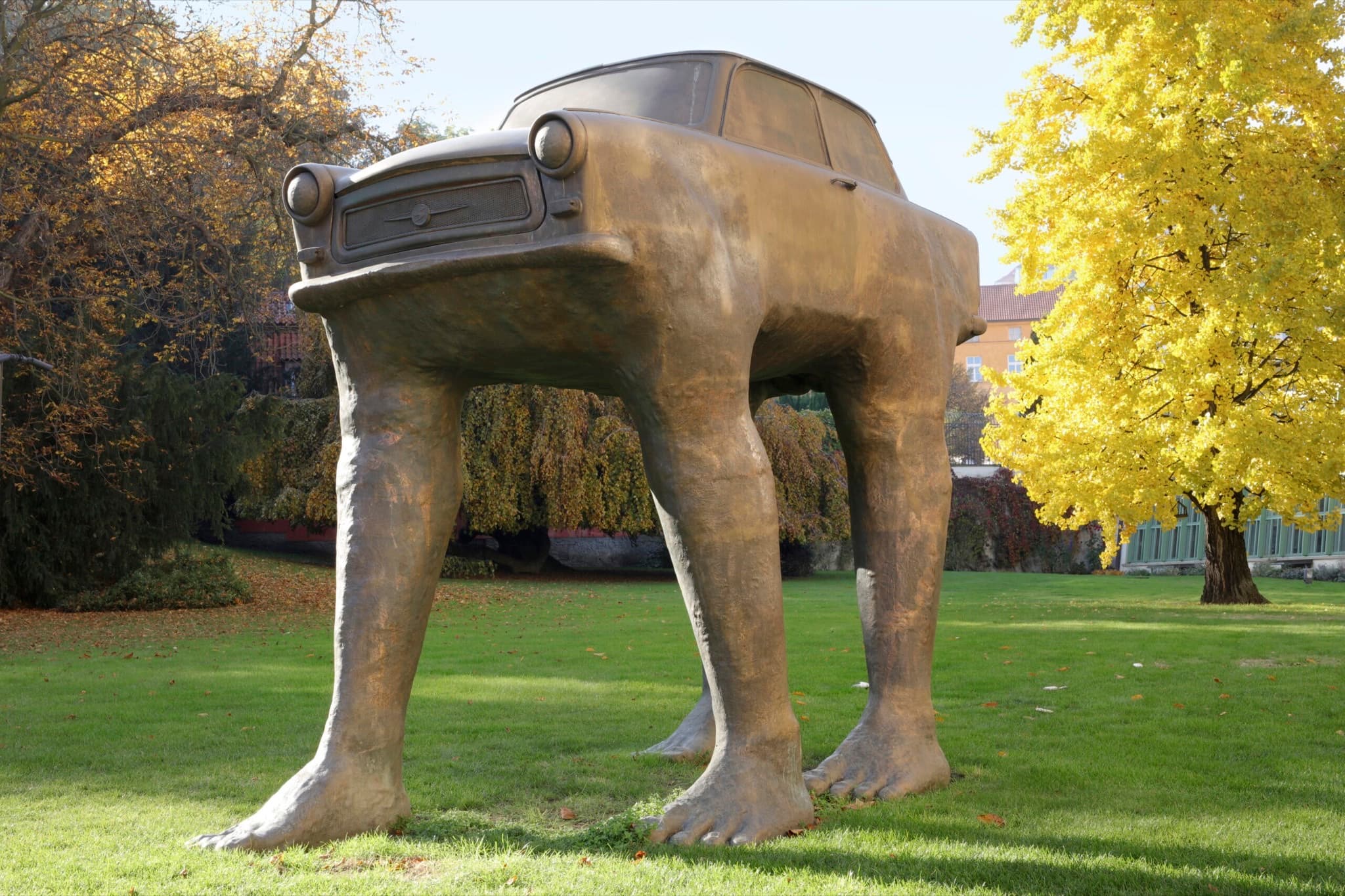
For a few weeks in the late summer of 1989, Prague became the scene of a bizarre — and now largely forgotten — refugee crisis. It had begun in the spring, when Hungary announced its decision to take down the barbed wire on its border with Austria. A growing number of East Germans, desperate at the suffocating lack of reform in their country, took advantage of this new gap in the Iron Curtain to flee to the West. Smuggling themselves into Austria was an uncertain business, however, and before long they began seeking refuge at the West German embassy in Budapest — and then in Prague, much closer to home and easier to reach, as East German citizens did not need a visa.
On 23 August 1989, the West German embassy — housed in the exquisite Baroque Lobkowicz Palace just below Prague Castle — was forced to close for day-to-day business. Hundreds of East Germans were trying to get in, many climbing over the fence into the manicured embassy gardens. The surrounding streets were soon packed with their abandoned Trabants and Wartburgs.
GALLERY
It’s only too often that sculptures go on to live their own lives, regardless of our intentions. The walking Trabant with the inscription “Quo vadis” was purely a thing of the times. We exhibited it on Old Town Square on the day of German monetary union. In the end the German embassy bought it from me, and a bronze cast Trabant now stands in the embassy garden. It’s the largest bronze cast made in the country since 1990. They probably also ascribed a meaning to it that was different from what we’d intended.
RELATED WORKS